
On November 4, CMS released its CY2027 Medicare Physician Fee Schedule final rule. For remote physiologic monitoring (RPM) and remote therapeutic monitoring (RTM), the announcement makes a clear operating plan especially useful.
For an organization considering an in-house program, the useful next step is to map the work: who enrolls patients, who notices a gap in readings, and who follows through. That map reveals where staff time goes and where better infrastructure can help.
Understand the Implementation Timeline
Starting in January 2027, RTM must be furnished to established patients, and practitioners reporting RPM or RTM must furnish a separately reportable initiating visit associated with starting services. CMS also finalized valuation changes. The requirement for clinical staff to be employed by the practice rather than contractors starts January 2029. CMS did not finalize the four-code bundling approach discussed during rulemaking.
Those dates call for a staged response. Organizations can review near-term enrollment and financial assumptions while planning how they want to operate over the longer term. Any reimbursement model should use final code-specific rates and the practice’s applicable payment conditions.
Make Enrollment a Repeatable Process
Enrollment should give the team a clear record of why monitoring is being started, what the patient needs to do, and who owns the next step. Review the path from the initiating visit through device setup and the first successful transmission. Look for places where a person must copy information, send a reminder, or check another system.
Assign responsibility for incomplete steps. If a device has arrived but readings have not, the team needs enough context to distinguish setup trouble from a connectivity issue or a patient who needs more guidance. A shared workflow makes it easier to see which task is still open.
This is also the point to confirm documentation and billing procedures with the practice’s responsible team. Technology can organize the record and support follow-through; the practice still needs to verify that the care and documentation satisfy the applicable requirements.
Give a Lean Team a Clearer Workday
An in-house program needs a manageable daily worklist. If staff begin each morning by checking several dashboards, rebuilding patient context, and deciding who needs follow-up, that preparation becomes part of the cost of every patient relationship.
Start with one repeatable task. For example, review how the team finds patients whose readings are missing. Measure the time spent locating the gap, checking device status, reviewing earlier outreach, and preparing the next action. That gives the practice a useful baseline for testing a different workflow.
Connect the Software Workflow to Device Operations
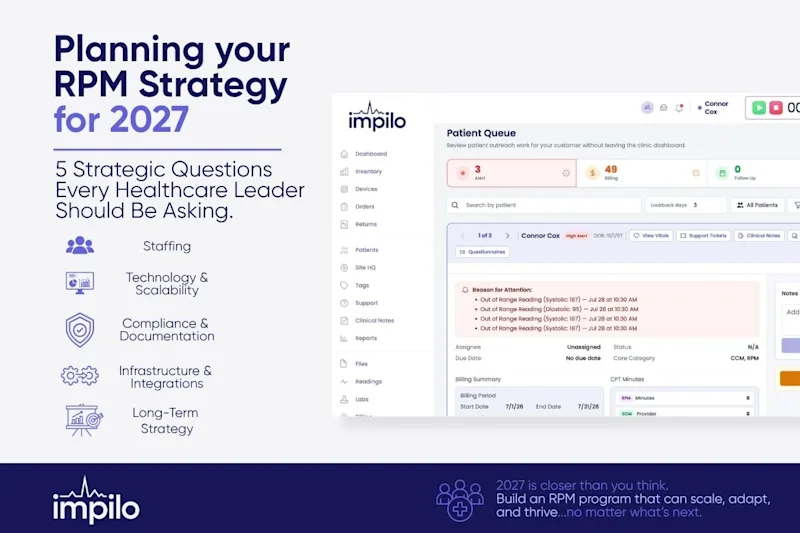
Impilo brings device data, program management, patient communications and engagement, and device operations into a connected platform. That foundation helps teams manage care-program activity in one place and reduces the need to reconcile separate views of the same patient.
The connection to physical operations matters. A follow-up may lead to additional patient guidance, troubleshooting, or a replacement device. Impilo’s device-agnostic fulfillment and logistics capabilities help connect that operational need to what reaches the patient’s home. The exact workflow should reflect the organization’s configuration and supported integrations.
For teams managing several care programs, a shared patient view also helps staff coordinate handoffs. Program requirements still need individual attention, but teams can organize the surrounding work with common context and clearer ownership.
Test the Operating Model Before Expanding
Evaluate an in-house program using the full cost of delivery. Include staff time, platform costs, devices and connectivity, logistics, implementation, and expected collections. Separate one-time transition costs from recurring expenses, and test how the model changes when participation or workload differs from expectations.
Then choose a focused pilot. Define the patient group, workflow owner, review steps, and measures before expanding. Track preparation time, unresolved follow-up tasks, and completion of the intended workflow. Use those findings to decide where automation helps and where people need more support.
Partnering with Impilo gives practices a way to bring software, operational workflows, and device infrastructure into the same plan. A useful first conversation is specific: choose one workflow that consumes staff time today and examine how it could work with better coordination.
To explore that approach, schedule an Impilo workflow discussion focused on your team’s current RPM process.
FAQ
Does the practice-employed staffing requirement start in 2027? No. CMS delayed implementation until January 2029. Practices can use that runway to evaluate their operating model and plan a staged transition.
How can a smaller team evaluate an in-house RPM program? Start by mapping the work and assigning responsibility for enrollment, monitoring, follow-up, and device issues. Test one workflow with a defined patient group and measure the staff time and support it requires before expanding.
What should an organization ask Impilo to demonstrate? Come prepared with a problem your team experiences today, such as missed readings or device follow-up. We'll provide a real life example workflow and Review the available data, staff approval steps, supported integrations, and how actions are recorded.