
Healthcare is at an interesting inflection point.
Over the past several years, remote patient monitoring (RPM) has evolved from an emerging reimbursement opportunity into a core component of many organizations' care delivery strategies. Health systems, physician groups, digital health companies, and value-based care organizations have invested heavily in bringing care beyond the four walls of the clinic.
But as we move into the second half of 2026, it's becoming clear that the conversation is changing.
Federal investments continue to expand access to virtual care, particularly in rural communities. Healthcare organizations are being asked to manage increasingly complex patient populations with limited clinical resources. Meanwhile, CMS has proposed changes to the Medicare Physician Fee Schedule that could reshape how some organizations structure their RPM programs, particularly those relying on third-party clinical teams for reimbursable services.
Whether those proposed changes are finalized exactly as written isn't the only story. The broader trend is.
Healthcare is moving toward greater accountability, stronger documentation, and operational models that can stand up to increasing regulatory scrutiny while supporting long-term growth.
For organizations already planning budgets, staffing models, and technology investments for 2027, this isn't the time to simply ask, "What RPM platform should we buy?" It's time to ask, "Is our remote patient monitoring strategy built for what's next?"
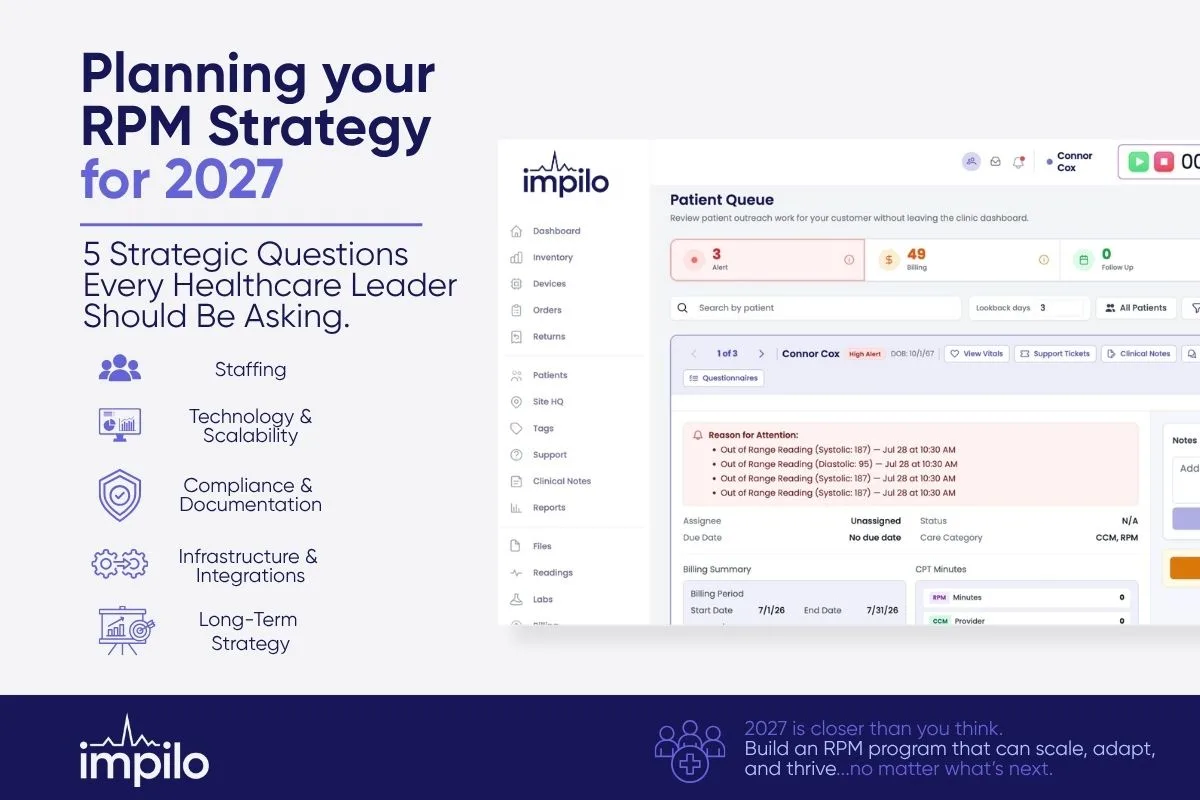
Here are five conversations healthcare leaders should be having before budgets are finalized.
1. Is Your Clinical Staffing Model Built to Adapt?
Many organizations launched RPM quickly by partnering with third-party clinical teams.
For many, it was the right decision. It allowed programs to launch faster, reduce hiring burdens, and begin serving patients without building an internal care management team from scratch.
But today's environment calls for a broader evaluation.
Healthcare leaders should understand exactly how their staffing model supports compliance, documentation, and operational visibility—and how flexible that model will be if reimbursement requirements continue to evolve.
Questions worth asking include:
If regulations change, how quickly can we adapt?
How dependent are we on outside resources?
Where does clinical accountability ultimately live?
Do we have visibility into the patient interactions supporting our billing?
This isn't about suggesting one staffing model is inherently better than another. Every organization has unique needs, patient populations, and operational constraints. It's about reducing surprises.
The organizations best positioned for the future will be the ones that understand exactly how teams fit into a compliant, scalable operating model. Not necessarily the ones with the largest teams.
2. Can Your Technology Handle the Program You're Planning to Build?
Many organizations selected their RPM technology based on the needs they had two or three years ago. Today, those needs look very different.
Patient volumes have increased. Care teams are managing more programs simultaneously. Expectations around reporting, patient engagement, and operational efficiency continue to rise.
The question is no longer whether your platform can collect blood pressure readings.
Nearly every platform can.
The question is whether your technology reduces the operational burden that comes with managing thousands of patients across multiple care programs.
Healthcare leaders should evaluate whether their technology helps them:
Prioritize patients requiring immediate attention
Centralize patient communications
Automate routine workflows
Manage device inventory and logistics
Track clinical time
Support compliant billing
Integrate cleanly with existing clinical systems
Technology should remove complexity and not force teams to have to monitor another dashboard throughout the day.
3. Is Your Organization Prepared for a Higher Standard of Compliance?
One of the clearest trends in healthcare is that documentation expectations continue to increase.
Organizations should expect greater emphasis on transparency, auditability, and operational consistency across virtual care programs. That means asking questions beyond reimbursement.
Can we confidently demonstrate:
When patients were engaged?
How much clinical time was spent?
What actions were taken?
Which readings triggered interventions?
Why a service was billed?
Strong documentation is operational intelligence. Organizations with complete audit trails gain better visibility into staffing, patient engagement, clinical performance, and program outcomes—allowing them to continuously improve rather than simply react.
4. Is Your Infrastructure Ready for What's Beyond RPM?
One of the biggest mistakes organizations make is treating RPM as an isolated program. In reality, many are already expanding into broader models of connected care.
Organizations are layering on:
Remote Therapeutic Monitoring (RTM)
Digital questionnaires and patient-reported outcomes
Preventive care initiatives
Population health programs
Home-based care
Rural health initiatives
Each new service introduces new operational demands. More devices, more patient touchpoints, more workflows, more documentation, and more reporting.
The organizations that struggle are lacking the infrastructure needed to connect everything in one place.
Disconnected systems force care teams to bounce between platforms, duplicate work, and manually piece together patient information. Over time, those inefficiencies become barriers to growth.
Scalable infrastructure allows organizations to expand services without proportionally increasing administrative burden. That's a competitive advantage that extends far beyond RPM.
5. Are You Choosing a Vendor or a Long-Term Operating Partner?
Perhaps the biggest shift happening in healthcare is how organizations evaluate technology vendors. A few years ago, the conversation often centered around devices.
Which blood pressure monitor should we use?
Which scale has the best connectivity?
Which dashboard has the most features?
Today, those questions are still important, but they're no longer sufficient. Healthcare leaders increasingly recognize that successful virtual care depends on everything happening around the device.
Patient onboarding, fulfillment, inventory management, technical support, data normalization clinical workflows, billing readiness, reporting, patient engagement, and regulatory adaptability.
The best technology decisions are made by asking which partner can help your organization continue evolving over the next five years—not just help you launch over the next five months.
Looking Ahead to 2027
Nobody knows exactly what healthcare reimbursement will look like in 2027.
The final Medicare Physician Fee Schedule may differ from this month's proposal. New rural health initiatives may emerge. Additional virtual care programs will almost certainly continue expanding.
Organizations don't need to wait for every policy decision before preparing. The most resilient RPM programs are built on operational fundamentals that remain valuable regardless of reimbursement changes:
Clear documentation
Efficient workflows
Connected infrastructure
Strong patient engagement
Reliable device operations
Flexible technology
Scalable processes
Those capabilities support better care delivery and don't just support compliance.
As healthcare organizations spend the remainder of 2026 planning budgets, evaluating technology, and preparing for another year of growth, the question should be whether they're building a virtual care program capable of adapting to whatever comes next.
While reimbursement models will continue to evolve, one thing is becoming increasingly clear: the future of remote patient monitoring will be defined by the operational infrastructure that enables care at scale.