

Automation conversations in RPM often begin with a feature list. A more useful starting point is the work itself.
Which tasks are repeatable?
Which decisions depend on context?
Which moments require human judgment or trust?
That distinction helps a team automate the work around care without obscuring accountability for the care itself.
The need is practical. A systematic review of 96 RPM studies found that adherence was reported in only 12% and satisfaction or acceptance in only 9%; variation across studies also limited comparison. A separate review of RPM experience measures found substantial inconsistency in how patient and staff experience is evaluated. These findings do not argue against automation. They suggest that implementation and human experience deserve explicit design attention.
First, Run the Staff-Memory Test
Ask what would slow down if one experienced teammate were out tomorrow. A process that depends on that person remembering when to check, whom to message, or where to find a record is a candidate for redesign. The goal is not to automate the person, but to remove avoidable memory work around the person.
Map the task with four questions:
What observable event starts the work?
What action usually follows?
How do we know the action is complete?
What exception requires a person to step in?
A task with clear answers is easier to automate safely than one whose rules change with every case.
Automate Repeatable Coordination
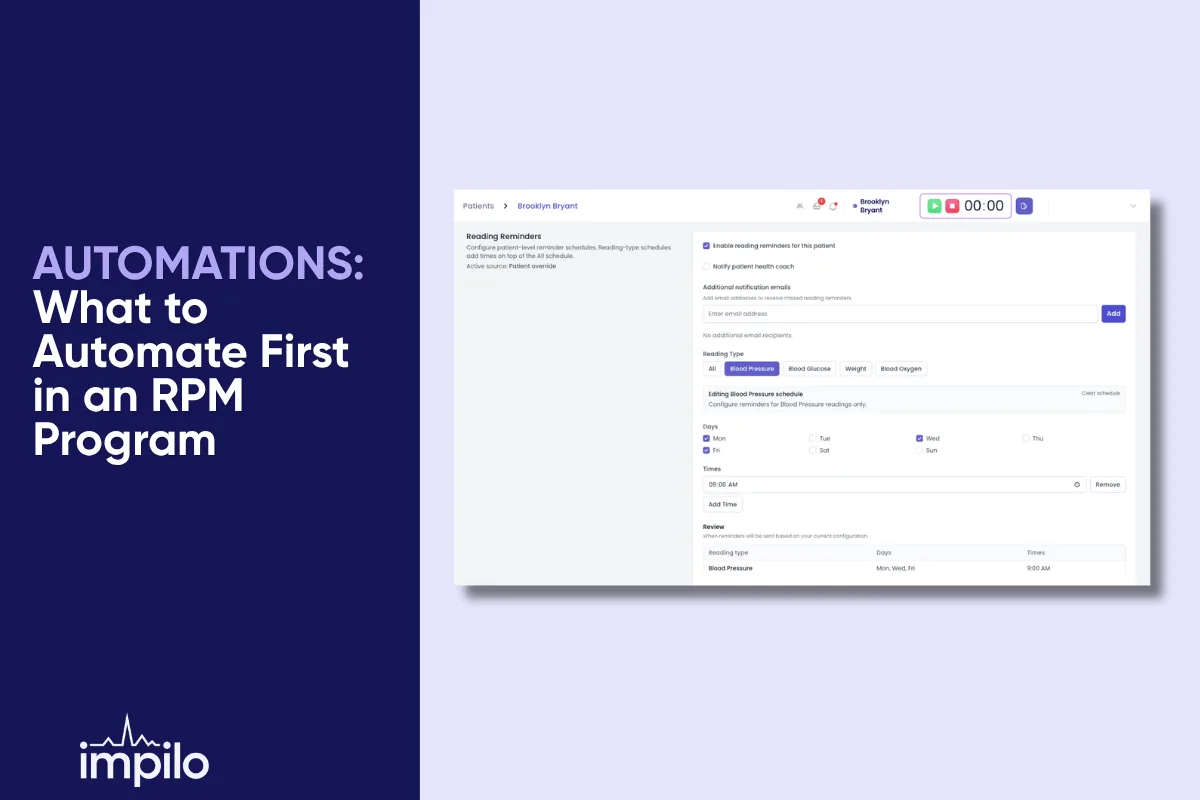
Strong first candidates tend to be high-frequency, low-ambiguity coordination tasks. Examples include detecting that an expected event has not occurred, sending an approved reminder, routing work to the correct queue, tracking a waiting period, and assembling operational records for review.
These tasks create disproportionate friction when performed manually because they require repeated checking and follow-up. They also have observable completion signals. A reminder was sent. A task was accepted. A response arrived. An exception was closed or escalated. Those signals make performance easier to monitor.
Assist Decisions That Need Context
Some work benefits from automation without becoming an automated decision. A prioritized worklist can help a clinician or operator decide where to look first. An exception summary can gather relevant history. A readiness check can show which records appear incomplete before a qualified reviewer evaluates them.
The distinction matters: the system reduces searching and organizes context; the person retains the decision. For each assisted workflow, identify what information the user needs, what uncertainty remains, and how the final action is recorded.
Keep Judgment and Trust Human-Led
Clinical interpretation, sensitive conversations, policy and compliance decisions, and unusual exceptions should remain appropriately human-led. Software may surface information or route the work, but the accountable role should stay visible. The team should also know how to pause an automation and how to recognize when it behaves unexpectedly.
Patient reminders illustrate the boundary. Automating the approved timing and delivery of a routine reminder may reduce manual work. Deciding how to respond to a distressed or confused patient requires context, empathy, and a responsible person. The workflow should make that handoff explicit.
Add Guardrails Before Scale
Before automating a task, define the owner, allowed action, stop condition, exception path, and audit trail. Then run a small pilot and review false positives, missed events, staff workarounds, and patient feedback. An automation that saves clicks but creates an invisible exception is not an operational improvement.
This is the direction we believe RPM infrastructure should move: less manual coordination, clearer context, and more visible accountability. Impilo already connects core RPM operations across devices, logistics, engagement, monitoring workflows, and data. As we think about the future of the platform, the most important question is whether the program becomes easier to run, understand, and improve.
Choose one task this week. Classify it as automate, assist, or keep human. If the team disagrees, use that disagreement to clarify the rule, the risk, and the owner. The best first automation is usually the one that removes recurring coordination work while making the human decision more visible.
FAQ
What should an RPM program automate first? Start with a frequent coordination task that has an observable trigger, a repeatable next step, and a clear completion signal—such as missing-event detection, approved reminders, routing, or wait tracking.
What RPM work should remain human-led? Clinical judgment, sensitive patient conversations, policy and compliance interpretation, and unusual exceptions should remain appropriately human-led, even when software organizes context or routes the task.
How can an RPM team evaluate an automation? Track whether it reduces manual checking, how often it creates false positives or misses, whether staff bypass it, whether patients respond as intended, and whether exceptions remain visible and owned.