
The CY 2027 CMS Proposal: Five RPM Workflow Questions to Answer Now

A proposed rule does not automatically create operational risk. More often, it exposes the risk that was already present.
The CY 2027 Medicare Physician Fee Schedule proposed rule includes several provisions relevant to remote physiologic monitoring and remote therapeutic monitoring. CMS has proposed a separately reportable initiating visit associated with the onset of RPM or RTM. It has also proposed limiting RTM to established patients and allowing payment for RPM or RTM services performed by clinical staff only when those staff are employed by the practice, not when the services are delivered by contractors.
CMS is also proposing valuation updates and seeking comments on a possible alternative structure that would bundle remote-monitoring services into four new HCPCS G-codes.
None of this is final.
That makes the period before the final rule a planning window. virtual programs do not need to predict exactly what CMS will decide. They do need to understand whether their current program can adapt.
Here are five questions to answer now.
1. Can You Trace the Start of Every Patient’s Program?
An initiating visit can sound like a simple requirement. Operationally, it can involve several handoffs.
Who confirms that the patient is eligible? What visit occurred? Where is it documented? What event triggers enrollment? Does the device ship automatically, or does someone manually approve the order?
If those steps happen across an EHR, spreadsheet, inbox, and vendor portal, the team may struggle to prove that the sequence happened correctly.
Map the journey from patient identification through the first successful reading. Name the owner, system of record, and completion signal for every step.
Do that before changing the workflow.
2. Does Everyone Agree on Who Performs the Work?
Many organizations describe ownership with one sentence: “The RPM team handles it.”
That is not specific enough for operational or regulatory planning.
Separate the work into clear categories:
Clinical review
Patient outreach
Device support
Adherence management
Alert escalation
Documentation
Billing review
Then identify who performs each task, who employs that person, who supervises the work, and where the completed activity is recorded.
Because the proposed rule contains specific language about clinical staff employed by the healthcare organization directly, organizations using external partners should review their model carefully with qualified billing, compliance, and legal advisors. They should not assume that all outsourced activity is treated the same or that the proposed language will be finalized unchanged.
3. Can You See the Entire Workflow in One Place?
A program can appear successful while remaining operationally fragile.
Enrollment may live in the EHR. Device orders may live in a vendor portal. Readings may appear in another dashboard. Patient communications may happen through phone calls and text messages in another platform. Billing documentation may be assembled manually at the end of the month.
Every disconnected step creates another place for information to be delayed, duplicated, or lost.
The key question to ask is whether the team can follow one patient from enrollment through monitoring, escalation, and billing without reconstructing the story manually.
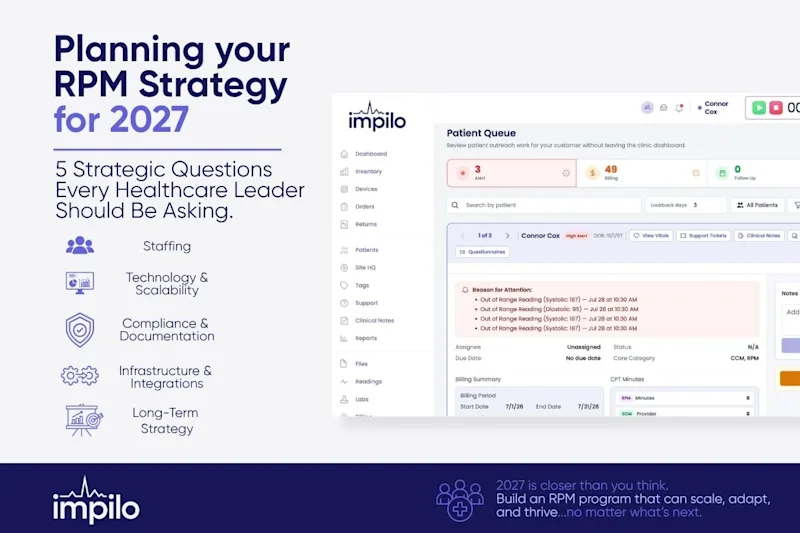
This is where platform-led infrastructure matters. Impilo brings devices, fulfillment, readings, alerts, patient communications, and automated workflows into one operating environment, giving teams a clearer view of what happened and what needs attention next.
4. Does Your Program Work Under More Than One Economic Scenario?
CMS says it is proposing valuation updates because remote-monitoring devices may be available at a lower cost than originally estimated. CMS is also requesting feedback on potentially bundling RPM and RTM services under a different code structure.
Virtual programs should avoid reacting to reimbursement figures that are not final. They should also avoid building a 2027 plan around only one possible outcome.
Model at least three scenarios:
The current structure largely continues.
Payment or valuation changes.
Staffing requirements or code structure change materially.
For each scenario, examine revenue, device expense, staffing capacity, cost to serve, patient adherence, and administrative burden.
A resilient program should deliver clinical and operational value without depending on every assumption remaining perfectly unchanged.
5. How Quickly Can the Program Adapt?
Policy readiness is the ability to change a workflow without rebuilding the entire program.
If a requirement changes, can your team update an enrollment trigger? Can responsibilities be reassigned? Can documentation rules be adjusted? Can the program distinguish clinical work from operational support? Can leaders see which patients or workflows are affected?
Programs built around manual workarounds usually change slowly because every update depends on retraining people and rebuilding spreadsheets.
Programs built on visible, configurable infrastructure can respond faster.
What to Do Before the Final Rule
Start with a one-page workflow.
Draw the patient’s path from identification to billing. Add the responsible person, system of record, documentation requirement, and failure point beneath every stage.
Then ask:
Where are the manual handoffs?
Where is ownership unclear?
Which steps depend on a contractor?
Which activity is difficult to document?
Which assumptions could change in 2027?
What can be improved regardless of the final rule?
The goal is to make the program easier to understand, operate, and adapt.
CMS may change the rules. Strong RPM operations should not require starting over every time it does.
FAQ
Is the CY 2027 CMS Physician Fee Schedule proposal final? No. CMS issued a proposed rule and is accepting comments through September 14, 2026. The remote-monitoring provisions may be revised before the final rule is published.
Does the proposal prohibit every type of outsourced RPM support? The proposal addresses payment for RPM or RTM services performed by clinical staff and states that those staff would need to be employed by the practice rather than contractors. Organizations should evaluate the specific activities in their model with qualified billing, compliance, and legal advisors instead of treating every external service as identical.
What should an RPM practice do right now? Document the current workflow, clarify ownership, identify contractor dependencies, audit documentation flow, and model several possible outcomes. Avoid making irreversible changes based solely on proposed language.