
RPM Alert Fatigue: How Smart Thresholds Help Care Teams Find the Signal
Remote patient monitoring gives care teams visibility between visits. However, visibility can become noise when every unusual measurement creates the same interruption.
An alert should help a team decide where to focus. If alerts are too frequent, poorly targeted, or disconnected from a clear response pathway, the system creates work without reliably improving the next clinical decision.
We're not saying the goal is to eliminate alerts, but make them more useful and targeted.
Why More Data Can Produce More Noise
RPM platforms can receive blood pressure, weight, glucose, oxygen saturation, heart rate, and other physiologic readings from a growing patient population.
A basic threshold may flag every value above or below a fixed number. That approach is easy to understand, but it may not account for measurement error, a patient’s baseline, the severity of the deviation, how long it persists, or whether the reading is part of a larger trend.
The result can be multiple alerts that require review but do not lead to clinical action.
The AMA Remote Patient Monitoring Playbook specifically advises organizations to protect physicians from an overwhelming influx of data. Its workflow guidance recommends defining protocols, supporting initial data analysis, identifying medically relevant information, and escalating data according to established processes.
That is the operational challenge: receiving the data is only the beginning. Programs also need a consistent way to interpret and route it.
What Current Research Suggests
A 2026 exploratory study examined continuous home monitoring after acute medical discharge. The study included 98 adults whose wearable devices measured heart rate, respiratory rate, blood pressure, and oxygen saturation.
Without filtering, patients generated a median of 74 alerts per day. When researchers applied artifact removal and clinical filters based on severity and duration, the median fell to five alerts per patient per day, which was an 84% reduction.
That result is promising, but it should not be generalized to every RPM program. The study involved continuous monitoring in a specific post-discharge population. Its authors also stated that further research is needed to evaluate clinical safety and predictive value.
A separate 2025 framework-development study examined blood-pressure telemonitoring data from 174 users. Of 17,293 alerts generated, 13,647 were processed automatically and 3,646 were processed manually by nurses. Twenty-five users generated more than half of the manually processed alerts.
Together, these studies illustrate an important principle: alert burden is not always distributed evenly, and thoughtful filtering can materially change the work reaching a clinical team.
What Makes a Threshold “Smart”?
A smart threshold is not a wider acceptable range. Depending on the condition and clinical protocol, useful alert logic may consider:
The severity of the reading
How long an abnormal value persists
Repeated abnormal readings
Change from the patient’s baseline
Trends across multiple days
Known measurement artifacts
Symptoms or other patient-reported information
The patient’s condition and care plan
Clinical leadership should define the protocols. Technology can apply those protocols consistently, organize the resulting work, and make the underlying data easier to review.
Automation should support clinical judgment.
Every Alert Needs a Response Pathway
Improving the threshold is only one part of alert management. Programs must also determine:
Who receives each type of alert?
How quickly it should be reviewed?
What information the reviewer needs?
When the patient should be contacted?
When the alert should be escalated
How the action is documented?
When emergency instructions apply?
Not every alert belongs with a physician. Some may be resolved through a repeat reading, device troubleshooting, or protocol-based outreach. Others require immediate clinical review.
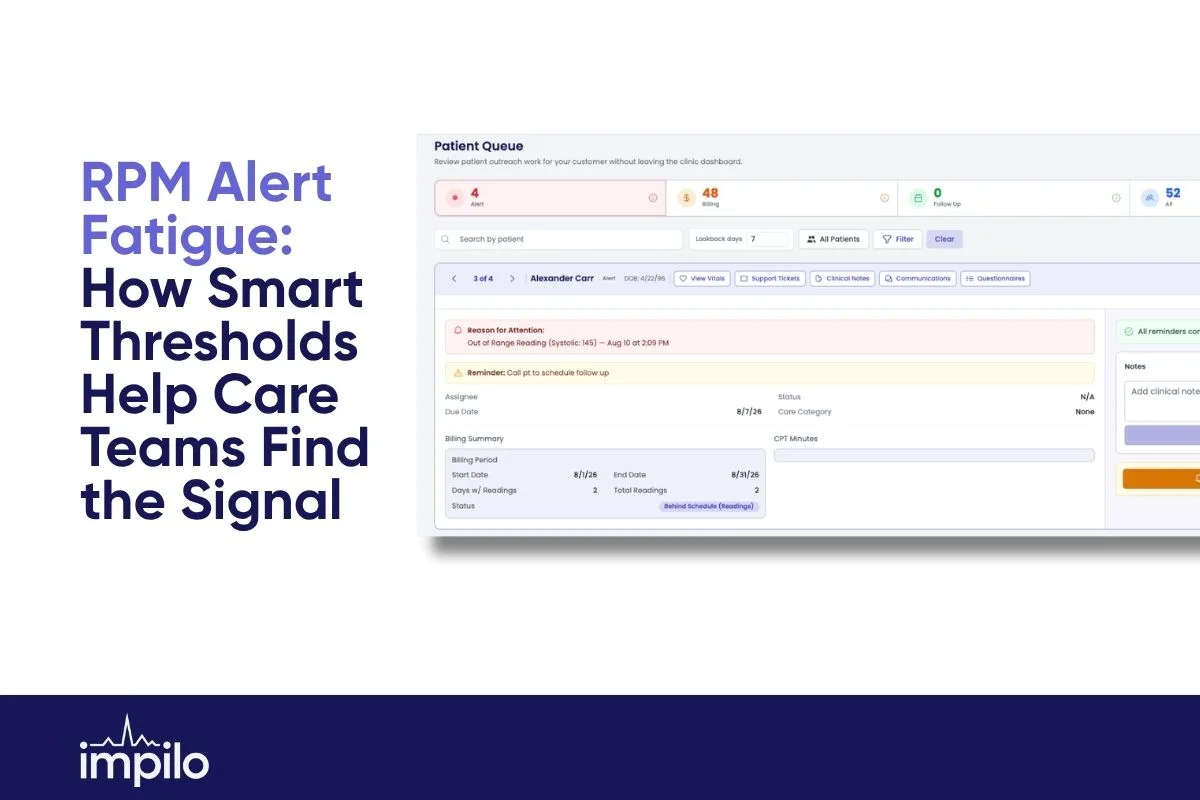
Impilo supports configurable thresholds, high-alert triage, patient communications, and workflow automation in one operating environment. Teams can move from the reading to the relevant patient context, document the response, and route the next action without piecing together separate systems.
Measure Alert Quality, Not Only Alert Volume
Reducing the total number of alerts can be useful, but it is not the sole objective. Programs should also examine:
Alerts per patient
Alerts by condition or device
Percentage requiring clinical action
Repeat alerts for the same event
Time from alert to review
Time from review to patient contact
Escalation rate
False or artifact-related alerts
Alert distribution across the patient population
A low alert count is not automatically a safe alert strategy, just like a high count is not automatically clinically valuable.
The better question is whether the alert helped the care team recognize, prioritize, and respond to meaningful risk.
Frequently Asked Questions
What is RPM alert fatigue? RPM alert fatigue occurs when care teams receive enough frequent or low-value alerts that reviewing them becomes burdensome. Excessive alerting may make it harder to prioritize the notifications most likely to require action.
Can smart thresholds replace clinical review? No. Smart thresholds can apply clinical protocols, filter data, and prioritize work, but they do not replace professional judgment. Clinical leaders should define and regularly evaluate the rules used in a monitoring program.
How can an RPM program reduce unnecessary alerts? Programs can examine measurement thresholds, severity, duration, repeated readings, patient baselines, and trends. Any adjustment should be evaluated for both workload effects and clinical safety.